Performance – the booster for websites
2021 will soon be behind us too, and right now there's no sign of the digital trend letting up. So wouldn't it be nice to start 2022 with a modern, and above all properly working, website – whether refreshed, completely rebuilt, or fresh off the XD or Figma board?

But what does “a properly working website” actually mean?
Working well in terms of how you speak to customers (content/design)? Or user-friendliness (UX/UI)? Or findability (SEO)? Or loading speed (performance)?
Fundamentally, it's important to know ALL the factors that determine the success of a website or online shop – and, with it, the success of the business. Here, though, we want to focus specifically on performance.
So what does performance actually mean?
Under the broad heading of “performance”, we're really talking about a website's loading time, which breaks down further into website speed (the site as a whole) and page speed (individual pages). That distinction matters, because the loading time of an individual page is especially critical for the homepage and for landing pages (specific target pages, for campaigns, say). Factors that can affect performance (loading time) include:
Media (images, videos)
CSS styles (i.e. the website's design rules for fonts, colours and so on)
JavaScript (for animations or other interactive content, for example)
Embedded external content (maps, videos, etc.)
The website's complexity and structure
Server response time
Redirects
Additional functionality (a shop, configurators, and so on)
And more
Performance as a commercial success factor
There used to be a saying: “you never get a second chance to make a first impression.” Today, it should probably be: “you never get more than two seconds to make a first online impression.” That's about as long as the average website visitor sticks around before deciding whether to keep reading or move on. In practice, that means your concept, design and content need to be good enough to keep visitors interested on the page (and ideally leave behind valuable information, like an address, email or preferences), and to get them exploring your offer straight away (and, in the best case, placing an order or generating revenue through your online shop). With mobile use on the rise, fast response and reaction times have become more important than ever.
Performance as a factor in successful search engine optimisation (SEO)
Search engines like Google base their algorithms on user trends. Since performance is a key factor here, it also influences a page's ranking in search results. In June 2021, Google introduced the Core Web Vitals – standardised metrics that pretty much every performance tool now refers to. They are:
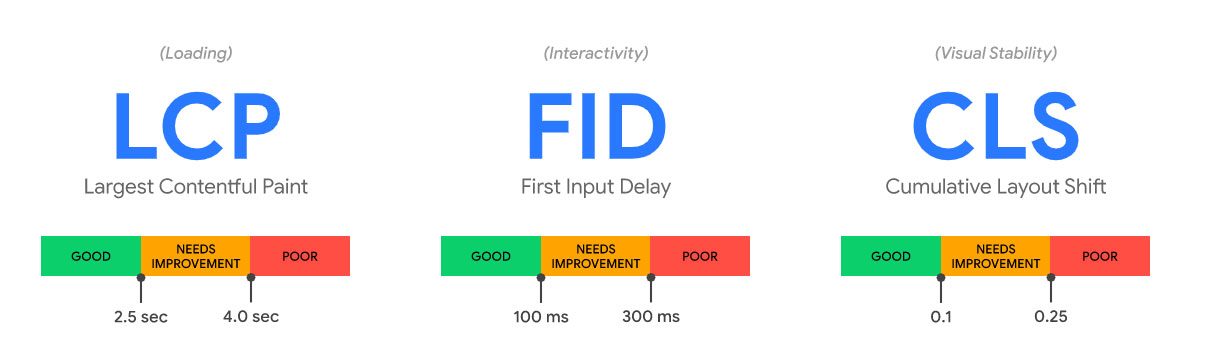
Image source: Google (https://web.dev/vitals/)
LCP is the point at which all of a page's main content has loaded and is displayed.
FID is the time the browser takes to respond to a user's first interaction (clicking a button, for example).
CLS flags problems caused by layout shifts after the initial load – for example, content suddenly jumping down the page and the user accidentally clicking the wrong thing.
Want to dig deeper?
We're also happy to run workshops on website performance for you and your team!
Get in touch now
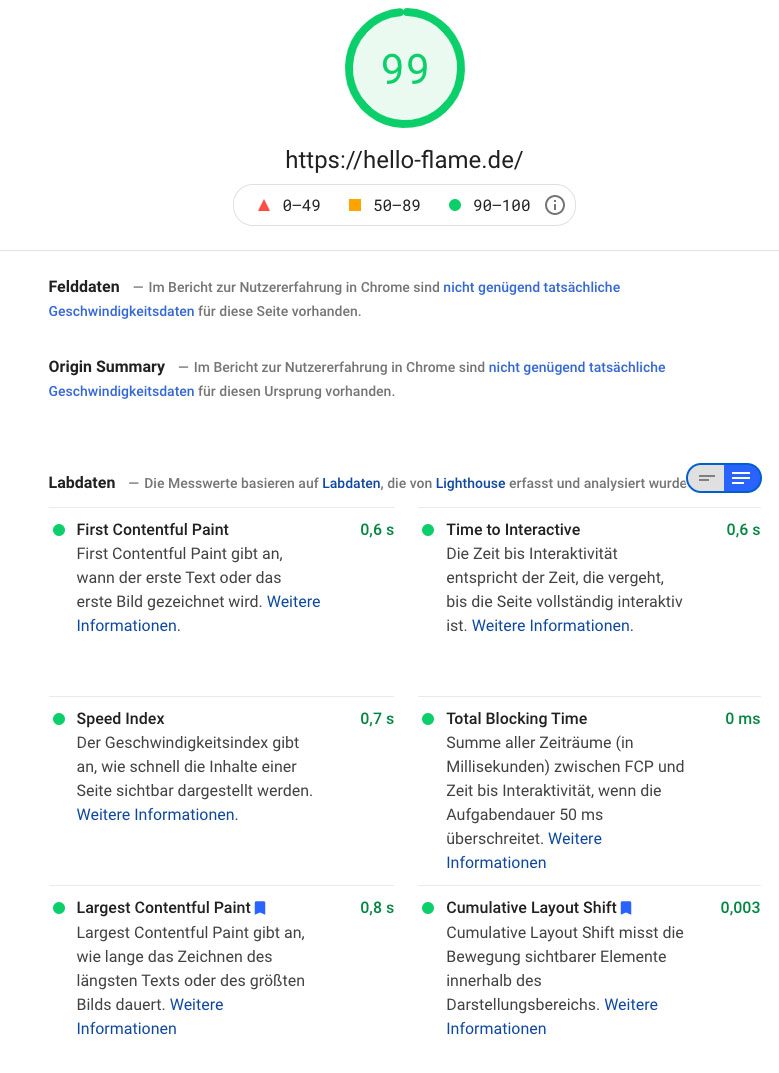
Other relevant metrics when analysing website performance include:
FCP: First Contentful Paint
The point at which the first element appears in the browser
TTI: Time to Interactive
The page has finished loading and the user can interact with it fully (clicking a button, using search, and so on)
TBT: Total Blocking Time
TBT is the total time during which the browser is blocked by long-running JavaScript tasks (over 50ms). The higher the TBT, the more it drags down overall performance.
More information is available at https://web.dev/vitals/
Performance isn't everything.
As mentioned at the start, fast loading times aren't the only criterion for a successful website – and they're not always the most important one either, because what still comes first is speaking to your target audience (often in a very specific way, and nobody knows them better than you do as a business). After all, the goal is to get users – and with them, prospects and customers – genuinely excited about your products or services, not to chase a speed record for your own website. So don't let loading time drive you round the bend; think carefully instead about which criteria really matter for your audience. Well-known brands like Apple or BMW, for example, lean into their image with an exceptional design and user experience (packed with motion elements), even if that means giving up on lightning-fast loading times.
Try our quick check: our performance package for WordPress websites
If you'd like to find out where your own WordPress website stands, we offer a performance package. We'll test your site with one of the leading performance tools and work with you to figure out the best solution. As long as your site isn't too outdated, basic optimisation (including image compression, enabling website caching, database clean-up and more) can already make a real difference to loading times.
Get your performance optimised now!
When we design and build a new WordPress website, we factor in current performance considerations from the start, and our maintenance packages keep your site technically up to date going forward.
Get in touch. We're happy to help.
And what fires you up?
Tell us what you’re working on right now — relaxed, over a coffee, virtually or in Munich-Sendling.
Arrange a chat